



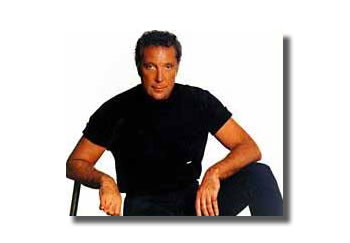



Tom
Jones |
|||||
 |
|
|
|||
It's not unusual when you become one of the most popular singers on the planet for fame to obscure the essentials of an artist. It is all too often forgotten. For example, that pop icon Tom Jones has a voice made for the blues, a drop-to-your-knees emotional style that captures the soul of R&B, and a presence that can only be described as rock ‘n' roll. In the end, the man who made wearing tight leather pants really hot and really cool and who has never taken his image too seriously even as women notoriously threw their hotel room keys onto the stage, is one helluva singer. His prodigious vocal power and endearing charisma have sustained his popularity for nearly 40 years. Now a new generation of fans has discovered him through his animated image seducing Marge Simpson on “The Simpsons,” the stunning international success of his 1999 album Reload (which went to #1 in the U.K. and throughout Europe) and it's updated 2003 American version Reloaded: Greatest Hits , and 2002's Mr. Jones , a collaboration with Wyclef Jean and Jerry “Wonder” Duplessis not yet issued in the U.S. By the time he was 17, this son of a Welsh coalminer had left school, was married and had a son. While working various jobs from construction worker to door-to-door vacuum salesman, he also sang in pubs at night with local groups. In 1963 he led his own band, Tommy Scott and the Senators. The record company mainstream, however, found him too controversial. Inspired by clues and R&B greats such as Solomon Burke, Little Richard and Jackie Wilson, his voice was raucous, his performance raw and bold. Finally, in 1964, he signed with Decca U.K. But his first single never took off. His second was a sensation. “It's Not Unusual” was deemed so sexual that it was banned by the BBC. Only when a pirate offshore radio station played the song did it become a #1 hit in the U.K. The following year, it charted at #10 in the U.S. After he opened for the Rolling Stones, gigged with the Spencer Davis Group and performed on “The Ed Sullivan Show” in 1965, his version of Burt Bacharach's “What's New Pussycat?” (from the film of the same name) reached #3. That same year he belted out the Top 30 theme to the James Bond flick Thunderball . He also won the Grammy as Best New Artist. Jones has sung everything from rock to R&B to show tunes to country. Elvis Presley, with whom he was friends, would warm up his voice to “Delilah” and The King would call radio stations to request a Jones country favorite, “Green, Green Grass of Home.” Each song was a Top 15 hit. “ Detroit City ” was another countrified outing. The ballad “(It Looks Like) I'll Never Fall In Love Again” went to #6 and was certified gold.. Then, in 1969, ABC signed him to the largest contract to that date between a TV network and a singing star for the variety series “This Is Tom Jones!”. The series included guests such as Elvis, Ray Charles, Aretha Franklin, Jerry Lee Lewis, The Who, Janis Joplin, Joe Cocker, The Supremes and others. But it was Jones who was catapulted to stardom. Between 1965 and 1971, when the series went off the air, he racked up 10 gold albums and 27 hit singles, nine of them Top 20. Along with those previously mentions, they include “She's A Lady” (#2 gold), “Without Love (There is Nothing)” (#5 gold), “Love Me Tonight” (#13) and “I (Who Have Nothing)” “Help Yourself”, “Can't Stop Loving You” and “Daughter Of Darkness”. During the rest of the ‘70s and through the ‘80s, he continued to record and his concerts continued to sell out. In the U.S. , he reached the country Top 40 with five albums and nine singles. In the U.K. he returned to the pop charts in 1987 with the ballad “It's Not Unusual” in London clubs, and when the song was re-released, it topped the charts there. In 1988, he was back in the U.S. pop Top 40 with his collaboration with the critically acclaimed Art of Noise on the Prince tune “Kiss.” The music video, in which he appeared, won MTV's Breakthrough Video of the Year award. Since then, Jones has once more been enthroned as the embodiment of hipness even as his worldwide concerts remain SRO. In 1992, he appeared before 75,000 fans at the famed Glastonbury Festival, the largest music festival in Europe, to a rave reception; VH-1 broadcast the six-part special “From Jones: The Right Time” and he was pictured as himself on “The Simpsons.” The 1994 album The Lead And How To Swing It , produced by the likes of Teddy Riley, Flood and Trevor Horn, spun off the single “If I Only Knew”, which scored a #4 Dance disc nearly 30 years after his first hit. 1999's Reload , a duets album with the likes of the Pretenders, Barenaked Ladies, Simply Red, The Cardigans, Portishead and Stereophonics, went six times platinum in the U.K. and sold more than 4,000,000 copies worldwide, becoming the biggest-selling album of his illustrious career. Numerous honors have followed, from performing at the White House Millennium Celebration and the Queen's Golden Jubilee at Buckingham Palace to receiving two Brit Awards for Best Male and Outstanding Achievement. In 2003, he notably appeared in the “Red White & Blues” segment of the monumental PBS series “The Blues”, executive produced by Martin Scorsese, directed by Mike Figgiss ( Leaving Las Vegas ), which dealt with the music of the early ‘60s British invasion that reintroduced the blues sound to America . Now with Reloaded: Greatest Hits and Mr. Jones , both of which include the funky “Tom Jones International” and the Leadbelly blues standard “Black Betty”, Tom Jones proves once again to be that most unusual perform, who not only has sustained his popularity over decades, but continues to grow and be challenged. |
|||||
©capitolweb
2003 |

